-
dazemoonmarketing
- August 24, 2026
- No Comments
Author’s Note:
This guide is intended for infrastructure professionals, contractors, plumbers, engineers, builders, municipal project teams, and buyers evaluating PE100 HDPE pipes for water-supply applications in India. Pipe performance depends on material grade, pressure rating, diameter, applicable standards, installation method, temperature, and operating conditions. Buyers should always verify the latest manufacturer datasheet, certifications, and project specifications before procurement.
Table of Contents
- What Are PE100 HDPE Pipes?
- Key Benefits of PE100 for Water Supply
- Applications, Sizes, and Selection Factors
- PE100 HDPE Pipe Cost and Quality Considerations
- FAQs
What Are PE100 HDPE Pipes?
PE100 is a high-performance polyethylene material grade commonly used for pressure pipe systems. The “100” designation relates to the material’s minimum required strength classification, with PE100 materials designed to provide a minimum required strength of 10 MPa under the relevant long-term testing conditions.
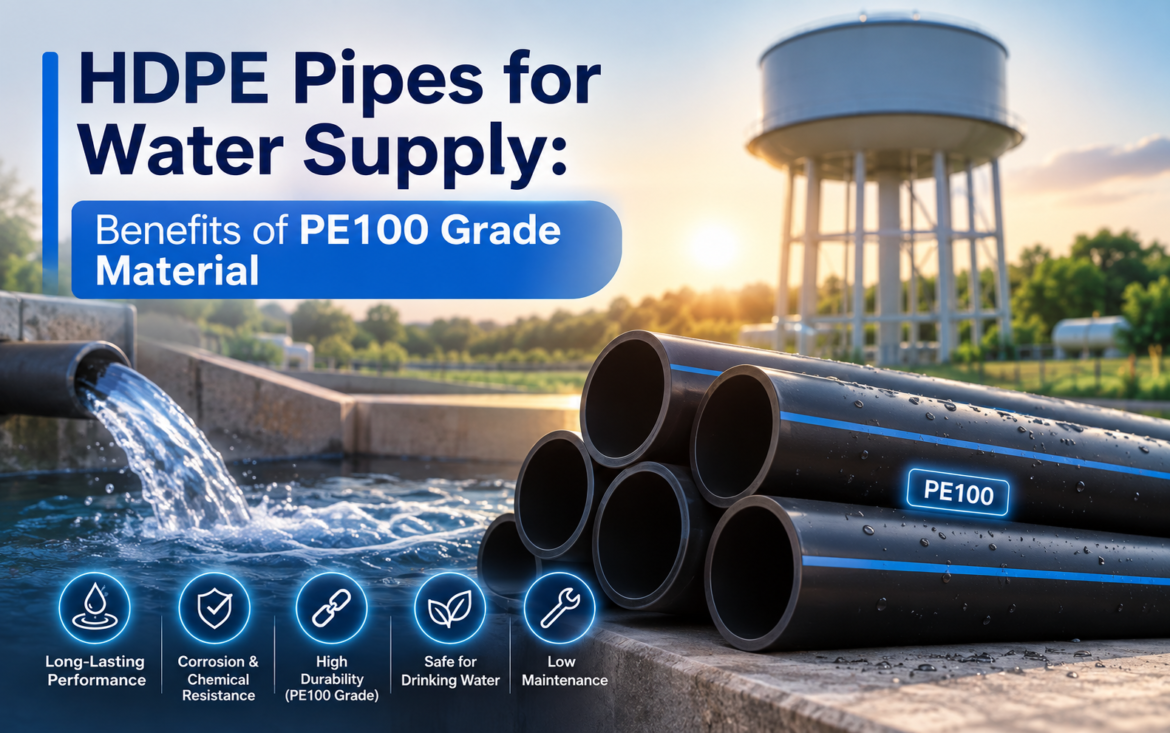
PE100 pipes are widely used in potable-water distribution, irrigation, industrial water systems, municipal networks, and other pressurised applications. Their combination of strength, flexibility, corrosion resistance, and long service life makes them suitable for both urban and rural infrastructure.
Compared with traditional rigid piping materials, polyethylene systems can accommodate ground movement and are generally easier to transport and handle. The fusion-jointed nature of many HDPE systems can also create continuous pipelines with fewer potential leakage points.
When evaluating hdpe pipe in India, buyers should not consider only the PE grade. The pipe’s outside diameter, wall thickness, SDR, pressure class, applicable standard, raw-material certification, and intended service conditions are equally important.
Key Benefits of PE100 for Water Supply
One of the biggest advantages of PE100 is its balance between strength and flexibility. This allows engineers to design reliable pressure pipelines while accommodating certain levels of ground movement and installation challenges.
1. High Pressure Performance
PE100 material is designed for pressure-pipe applications and can be manufactured in different SDR configurations. The selected SDR and pressure rating should match the system’s operating pressure, surge conditions, temperature, and design requirements.
2. Corrosion and Chemical Resistance
Unlike metallic pipes, polyethylene does not rust. It also provides good resistance to many naturally occurring chemicals and substances found in soil and water. This makes it useful in environments where corrosion could affect conventional metal pipelines.
3. Leak-Resistant Jointing
HDPE pipes can commonly be joined through butt fusion or electrofusion. When correctly performed using suitable equipment and procedures, fusion can create a strong, continuous joint. This can reduce the number of mechanical joints and potential leakage locations across a pipeline.
4. Long-Term Service Potential
PE100 systems are designed for long-term pressure service when correctly specified and installed. However, actual service life depends on operating temperature, pressure cycles, water chemistry, installation quality, external loads, and compliance with the relevant design standard.
5. Lightweight and Flexible
HDPE is considerably lighter than many traditional pipe materials. This can simplify transportation, handling, trench installation, and project logistics. Its flexibility can also be beneficial where pipelines need to follow changing terrain or accommodate controlled directional changes.
Applications, Sizes, and Selection Factors
PE100 water-supply pipes are used in several applications, including municipal drinking-water networks, rural water distribution, irrigation, industrial water transportation, housing developments, and water-treatment infrastructure.
The correct size should be selected based on required flow, allowable pressure loss, operating pressure, available pumping capacity, pipeline length, and future demand. Diameter alone does not determine performance; wall thickness and SDR are equally important.
For example, a high-pressure municipal pipeline may require a different PE100 configuration from a low-pressure agricultural water line. Engineers should therefore calculate hydraulic requirements before purchasing.
The Indian market includes many polyethylene products designed for different purposes. Buyers researching hdpe pipe manufacturers should confirm whether the product is specifically certified and designed for potable-water pressure applications rather than assuming that every HDPE pipe is interchangeable.
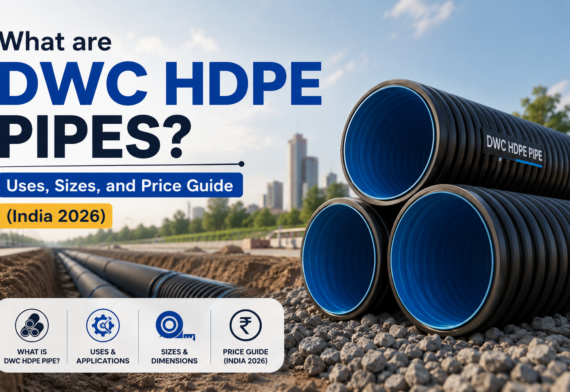
It is also important to distinguish pressure water pipes from products such as dwc pipe in India, which are primarily associated with structured-wall ducting and drainage or cable-protection applications.
Similarly, sprinkler pipe in india may refer to agricultural irrigation products, while mdpe pipe in india generally refers to medium-density polyethylene systems used in applications such as gas distribution. These products should not automatically be substituted for PE100 water-pressure pipes.
For telecom infrastructure, plb duct pipes in india are specialised products intended for optical-fibre cable installation and have different design requirements from water-supply pipes. Likewise, SWC Hdpe Pipes in india may represent another structured-wall product category and should be assessed according to its intended application and technical specification.
PE100 HDPE Pipe Cost and Quality Considerations
The price of PE100 pipes in India varies according to diameter, SDR, pressure rating, raw-material grade, quantity, manufacturer, certification, transportation, and market conditions. Therefore, a single “per metre” price cannot accurately represent every PE100 water-supply pipe.
When requesting a quotation, provide the supplier with the required diameter, SDR or pressure class, pipe length, application, quantity, delivery location, applicable standard, and any testing or certification requirements.
A quality-focused procurement process should consider more than price. Important checks include:
- PE100 raw-material certification
- Applicable BIS or project standard
- Dimensional accuracy
- Hydrostatic pressure testing
- Fusion-joint compatibility
- Manufacturer quality-control procedures
- Batch traceability
- Technical documentation
- Warranty and after-sales support
For potable-water projects, the material and finished pipe should also comply with the applicable requirements for contact with drinking water. Project engineers should review the latest relevant Indian standards and client specifications before approval.
FAQs
1. What is PE100 in HDPE pipes?
PE100 is a high-strength polyethylene material classification used extensively for pressure pipe systems. It is designed for long-term performance under specified operating conditions.
2. Why is PE100 suitable for water supply?
PE100 offers high strength, flexibility, corrosion resistance, lightweight handling, and reliable fusion jointing, making it suitable for many pressurised water-distribution systems.
3. Are PE100 pipes suitable for drinking water?
Yes, PE100 pipes can be used for potable-water systems when the complete pipe system, raw material, manufacturing process, and certifications meet the applicable drinking-water and project requirements.
4. How do I choose the right PE100 pipe size?
Selection should be based on flow requirements, pipeline length, operating and surge pressure, pressure losses, temperature, installation conditions, and the required design life. An engineer should perform the hydraulic and structural calculations.
5. Is PE100 better than traditional metal water pipes?
PE100 can offer significant advantages such as corrosion resistance, lower weight, flexibility, and fusion jointing. However, the best pipe material depends on project conditions, pressure requirements, installation environment, budget, and applicable standards.