-
dazemoonmarketing
- September 25, 2026
- No Comments
Author’s Note: This guide is prepared for telecom contractors, procurement teams, infrastructure developers, and suppliers participating in BSNL, RailTel, and other telecom tenders. Specifications may vary by tender, project location, and applicable technical amendments. Always verify the latest tender documents before submitting a bid.
Table of Contents
- Understanding PLB Duct Pipes in Telecom Projects
- Key Technical Specifications Required in Tenders
- Quality, Testing, and Tender Documentation
- How to Select a Compliant Supplier
- Frequently Asked Questions
1. Understanding PLB Duct Pipes in Telecom Projects
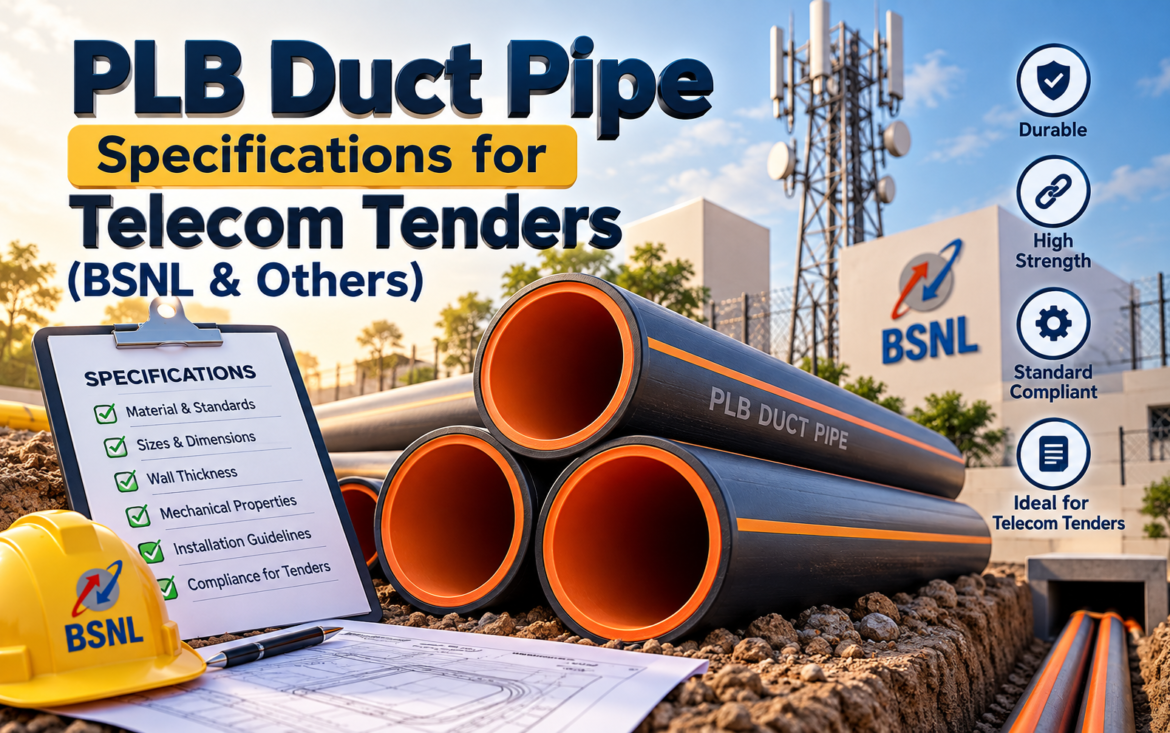
PLB (Permanently Lubricated) HDPE duct pipes are specialised conduits used to protect underground optical fibre cables in telecom infrastructure. Their smooth, low-friction inner surface helps reduce resistance during cable pulling or blowing, supporting efficient installation over long distances.
In BSNL and other telecom projects, PLB ducts are used for underground optical fibre networks, broadband connectivity, and long-distance communication routes. Recent BSNL and RailTel procurement documents reference 40/33 mm PLB telecom ducts and RDSO specifications, although the exact requirements depend on the individual tender. <Cite refs={[“turn480303search14″,”turn480303search7”]}/>
For contractors sourcing plb duct pipes in india, understanding the technical schedule is essential. A pipe that meets general commercial requirements may still be rejected if its dimensions, material properties, accessories, or certification do not match the tender.
2. Key Technical Specifications Required in Tenders
The technical specification is the foundation of tender compliance. The following parameters should be checked before finalising a product or quotation.
| Specification | What to verify |
|---|---|
| Material | High-density polyethylene suitable for telecom ducting |
| Nominal dimensions | Common 40/33 mm configuration, subject to tender |
| Inner surface | Permanently lubricated, low-friction internal layer |
| Construction | Uniform wall thickness and consistent internal diameter |
| Mechanical properties | Tensile strength, elongation, impact resistance, and flexibility as prescribed |
| Accessories | Compatible couplers, end caps, connectors, and sealing components |
| Identification | Manufacturer details, size, batch number, and required markings |
The 40/33 mm designation generally refers to a nominal 40 mm outside diameter and 33 mm inside diameter. However, bidders must follow the dimensional tolerances and measurement procedures specified in the applicable standard.
A commonly referenced technical document is RDSO/SPN/TC/45/2013, including its applicable revisions and amendments. RailTel’s 2026 procurement terms refer to Revision 2.0 with Amendment 3.0 and subsequent applicable amendments. <Cite refs={[“turn480303search14”]}/>
Do not assume that an older revision automatically satisfies a new tender. The purchaser’s specified revision and any special conditions take precedence.
3. Quality, Testing, and Tender Documentation
Telecom tenders generally evaluate both technical compliance and the bidder’s supporting documents. A complete submission should demonstrate that the supplied material meets the stated requirements.
Important checks include:
- Material test reports: Confirm that the reports cover the required mechanical and physical properties.
- Dimensional inspection: Verify the outside diameter, inside diameter, wall thickness, and permitted tolerances.
- Lubrication performance: Check that the inner layer meets the prescribed friction or cable-installation performance requirements.
- Traceability: Ensure batch identification, manufacturing details, and inspection records are available.
- Inspection and acceptance: Follow the purchaser’s sampling, testing, inspection, and approval procedures.
The tender may also require manufacturer authorisation, experience certificates, past supply orders, financial eligibility documents, or inspection certificates. These requirements should be treated separately from the pipe’s technical specifications.
For contractors working with hdpe pipe manufacturers, obtaining a complete technical datasheet and relevant test documentation before bidding can help identify compliance gaps early.
BSNL’s official e-procurement listings include PLB duct supply and installation works, sometimes alongside open-trench or HDD activities. This means contractors should carefully distinguish between a supply-only tender and a turnkey or installation tender. <Cite refs={[“turn480303search1″,”turn480303search3”]}/>
4. How to Select a Compliant Supplier
Supplier selection should focus on documented manufacturing capability, product consistency, and tender-specific compliance rather than price alone.
First, compare the manufacturer’s technical datasheet against every requirement in the tender. Confirm that the quoted product matches the required diameter, material grade, construction, and applicable standard.
Second, check production capacity, quality-control procedures, delivery timelines, and the availability of compatible accessories. For large projects, consistent batch quality and dependable delivery are important to prevent installation delays.
Third, clarify whether the supplier can provide inspection support, test reports, and technical assistance during project execution.
The same verification approach applies when procuring hdpe pipe in India for broader infrastructure projects. Products such as dwc pipe in India, sprinkler pipe in india, mdpe pipe in india, and SWC Hdpe Pipes in india serve different applications and should not be treated as interchangeable with permanently lubricated telecom ducts.
A technically compliant product, supported by traceable documentation and appropriate quality checks, helps contractors prepare more reliable tender submissions and manage project risks.
Frequently Asked Questions
1. What is the commonly used PLB duct size in telecom tenders?
A 40/33 mm duct is commonly specified for underground optical fibre cable applications. However, bidders must follow the exact dimensions and tolerances mentioned in the tender.
2. Which standard is referenced for PLB telecom ducts?
RDSO/SPN/TC/45/2013 is a commonly referenced specification. The applicable revision and amendments must be confirmed from the tender documents.
3. Are PLB ducts mandatory for every BSNL project?
Not necessarily. The purchaser specifies the duct type, size, accessories, and installation requirements according to the project’s design and scope.
4. What documents should suppliers provide?
Typically, relevant technical datasheets, test reports, batch traceability records, and other certificates or approvals specifically requested in the tender.
5. Can a contractor quote a technically similar duct?
Only if it satisfies the tender requirements and any permitted equivalent-product provisions. Written purchaser approval should be obtained wherever required.