-
Keshav Kripa Polyplast
- October 27, 2026
- No Comments
Author’s Note: Choosing the right duct is essential for reliable fibre-optic cable installation, especially in telecom and underground communication networks. This guide compares permanently lubricated HDPE ducts with conventional conduits, focusing on cable-blowing efficiency, installation conditions, and long-term performance. Actual results depend on duct specifications, cable dimensions, installation equipment, and site conditions. Always consult the manufacturer’s technical documentation and applicable project requirements before selection.
Table of Contents
- Understanding PLB HDPE Ducts and Normal Conduits
- Differences in Cable-Blowing Efficiency
- Installation Factors That Affect Performance
- How to Select the Right Duct
- Frequently Asked Questions
Understanding PLB HDPE Ducts and Normal Conduits
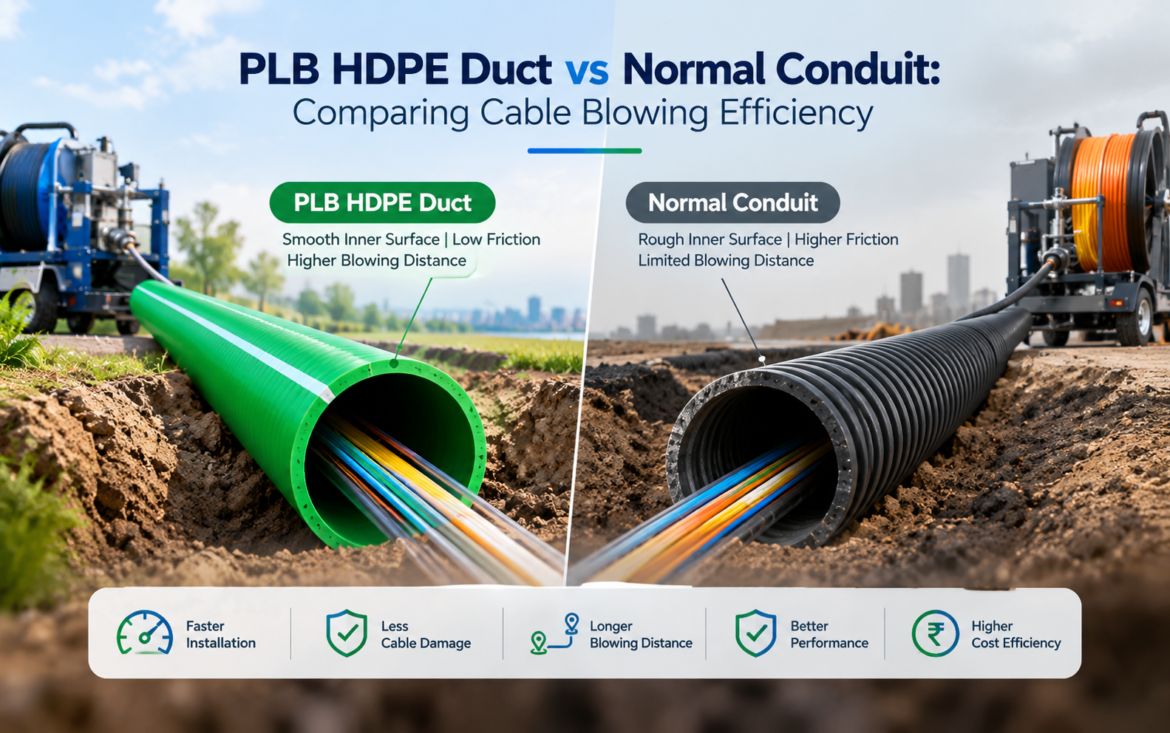
PLB HDPE ducts are specialised polyethylene ducts designed primarily to protect optical fibre cables and support installation using cable-blowing equipment. PLB stands for Permanent Lubricant Barrier. The internal layer is designed to provide low friction, helping the cable move through the duct when installed using an appropriate blowing system.
Normal conduits are a broader category that includes PVC, HDPE, and other conduit types. They may have smooth or corrugated interiors and are commonly used to protect electrical wires, communication cables, and building services. Their suitability for fibre blowing depends on their internal surface, dimensions, jointing system, and the manufacturer’s intended application.
For long-distance fibre-optic networks, selecting a duct specifically designed for cable blowing can help improve installation efficiency and reduce the risk of cable damage.
Why the Internal Surface Matters
During cable blowing, compressed air and specialised equipment help propel a fibre-optic cable through a duct. Friction between the cable and duct wall can influence how far the cable travels and how much force is required.
A purpose-designed PLB duct provides a low-friction inner surface to support this process. A conventional conduit may still be suitable for certain cable installations, but its performance should not be assumed equivalent without checking its specifications and compatibility with the cable-blowing method.
Differences in Cable-Blowing Efficiency
Friction and Installation Distance
Cable-blowing performance depends on several interacting factors, including internal friction, duct diameter, cable weight, air pressure, airflow, route length, and the number of bends.
PLB ducts are designed to support low-friction cable installation, which can be beneficial on long routes where friction can limit progress. However, a low-friction surface alone does not guarantee a particular installation distance. The duct and cable combination must be compatible with the blowing equipment and installation plan.
Conventional conduits may work effectively for shorter routes or installations involving cable pulling, provided the product is designed for that purpose. If cable blowing is planned, confirm that the conduit is approved for the method and has appropriate dimensions and jointing arrangements.
Bends, Joints, and Cable Protection
Sharp bends, misaligned joints, internal obstructions, and damaged duct ends can increase resistance or prevent a cable from passing through successfully. These issues can affect both PLB ducts and normal conduits.
PLB duct systems are often selected for telecom infrastructure because they can provide a consistent pathway for fibre installation when correctly specified and installed. Before installation, inspect the duct for deformation, contamination, and damage. Use compatible couplers and sealing components to prevent soil, water, or debris from entering the system.
Installation Factors That Affect Performance
Correct Sizing and Route Planning
Duct size should be selected according to the cable’s outside diameter, the manufacturer’s recommended fill limits, the blowing equipment, and the project’s technical specifications. A duct that is too small can increase installation resistance, while an unsuitable oversized duct may affect airflow and blowing performance.
Plan the route to minimise unnecessary bends and ensure that the duct’s minimum bend radius is respected. Long installations may require intermediate access points or a route design approved by the project engineer.
For buyers comparing plb duct pipes in india, check the required internal and external diameters, wall construction, lubrication performance, material properties, and applicable tender specifications rather than choosing by price alone.
Quality Checks Before Cable Blowing
Before blowing begins, verify that the duct is clean, continuous, properly joined, and free from obstructions. Follow the equipment manufacturer’s instructions for air pressure, airflow, cable handling, and lubrication requirements.
Reliable hdpe pipe manufacturers should provide product datasheets and technical guidance for the intended application. Products such as hdpe pipe in India may be supplied for different purposes, so buyers should not assume that a general-purpose HDPE pipe is suitable for fibre blowing.
Likewise, dwc pipe in India and SWC Hdpe Pipes in india typically refer to corrugated products used in specified drainage or cable-protection applications. sprinkler pipe in india and mdpe pipe in india refer to products associated with different operating requirements. Their suitability depends on their design and approved application, not simply on the polymer name.
How to Select the Right Duct
The best choice depends on the cable installation method, route length, site conditions, cable specifications, and project standards. PLB HDPE ducts are generally a strong option when low-friction cable blowing is a key requirement. Normal conduits can be suitable for conventional wiring or other cable installations where their design meets the project’s needs.
For a reliable decision, review technical datasheets, relevant test reports, compatibility with the cable-blowing system, jointing requirements, and manufacturer recommendations. Where the project involves long-distance fibre installation, seek guidance from a qualified telecom engineer or experienced cable-installation contractor.
Frequently Asked Questions
1. What is the main advantage of a PLB HDPE duct?
Its purpose-designed low-friction inner layer helps support fibre-optic cable blowing when the duct, cable, and equipment are compatible.
2. Can normal conduit be used for fibre-optic cable blowing?
Sometimes, but only when its design, dimensions, internal surface, and manufacturer specifications support the intended installation method.
3. Does a PLB duct always allow longer cable-blowing distances?
No. Performance also depends on route geometry, duct size, cable properties, airflow, equipment settings, and installation quality.
4. Why are duct joints important during cable blowing?
Poorly aligned or incompatible joints can create obstructions, increase friction, and damage the cable or interrupt installation.
5. What should buyers check before purchasing a PLB duct?
Verify dimensions, material properties, lubrication performance, applicable standards, compatibility with the planned cable, and the manufacturer’s technical documentation.