-
dazemoonmarketing
- August 30, 2026
- No Comments
Author’s Note:
This guide is prepared for telecom contractors, network planners, infrastructure developers, fibre-optic installers, electrical contractors, and procurement teams looking to understand PLB duct pipes and their role in underground communication networks. Product specifications, dimensions, installation methods, and performance requirements can vary by manufacturer and project. Always verify the latest technical datasheet, applicable Indian standards, and project specifications before procurement or installation.
Table of Contents
- What Are PLB Duct Pipes?
- Why PLB Ducts Are Used for Fibre-Optic Cables
- Types, Sizes, and Important Specifications
- PLB Ducts vs Other HDPE Ducting Solutions
- How to Select the Right PLB Duct
- FAQs
What Are PLB Duct Pipes?
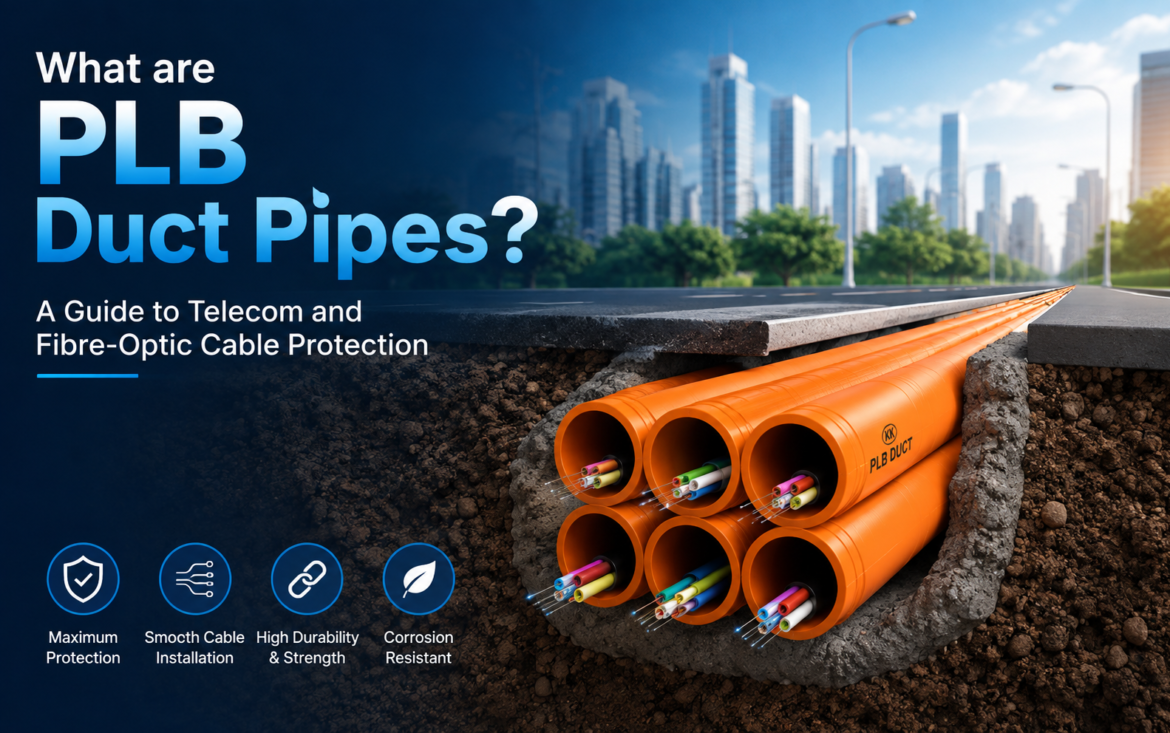
PLB duct pipes are specialised polyethylene ducts designed to protect and facilitate the installation of optical-fibre cables in underground telecommunications networks. PLB commonly refers to Permanent Lubricant Barrier, describing a duct design that incorporates a low-friction inner surface to make fibre-cable installation easier.
Unlike conventional solid-wall pipes used primarily for transporting fluids, PLB ducts function as protective pathways for communication cables. Their internal surface is designed to reduce friction during cable pulling or blowing, while the duct itself provides protection from soil pressure, moisture, mechanical impact, and other external conditions.
The growing deployment of broadband, 5G infrastructure, fibre-to-the-home (FTTH), data centres, smart-city networks, and enterprise connectivity has increased the importance of reliable underground fibre infrastructure. Properly selected ducting can protect expensive fibre cables while also allowing network operators to install, replace, or expand cables without repeatedly excavating the road or ground.
When researching plb duct pipes in india, buyers should evaluate the duct’s material, dimensions, internal friction characteristics, pressure or mechanical requirements, installation method, applicable standards, and manufacturer’s quality documentation rather than choosing solely on price.
Why PLB Ducts Are Used for Fibre-Optic Cables
Fibre-optic cables are capable of carrying large volumes of data, but the cable itself needs protection throughout its service life. Underground installation exposes cables to construction activity, ground movement, moisture, traffic loads, rodents, and accidental mechanical damage.
A properly designed PLB duct creates a dedicated route for the cable and provides several practical benefits.
Reduced Installation Friction:
The specialised inner surface can help reduce friction between the duct and cable. This is particularly valuable when long lengths of fibre are installed using cable-blowing or pulling techniques.
Mechanical Protection:
The duct provides an additional protective barrier around the fibre cable. The required wall construction and stiffness depend on burial depth, traffic loading, soil conditions, and installation method.
Moisture Protection:
A continuous duct system can help shield fibre cables from direct contact with surrounding soil and water. Joints and end closures must nevertheless be properly installed to maintain system integrity.
Network Expansion:
One of the major advantages of duct-based infrastructure is future scalability. Spare ducts or appropriately designed pathways can provide additional capacity for future cables without requiring extensive excavation.
Long-Term Durability:
Polyethylene is resistant to corrosion and can tolerate many environmental conditions. Its flexibility also helps it accommodate certain ground movements more effectively than some rigid materials.
Types, Sizes, and Important Specifications
PLB ducts are available in different dimensions and configurations depending on the cable size, installation technique, network design, and project requirements. Common specifications can include duct outside diameter, inside diameter, wall thickness, coil length, colour, identification markings, and mechanical properties.
For fibre-optic applications, the internal diameter is particularly important because the duct must provide sufficient clearance for the intended cable and installation method. A duct that is too small can increase installation difficulty, while excessive clearance may not always be optimal for particular blowing systems.
The choice between straight lengths and coiled ducts can also depend on the project. Coiled products can be convenient for long continuous installations, while straight lengths may be preferred for specific civil or network configurations.
Quality control is equally important. Buyers should request manufacturer documentation covering raw-material grade, dimensional tolerances, relevant testing, batch identification, and applicable standards.
It is also important to distinguish PLB ducts from other polyethylene products. hdpe pipe in India covers a broad category that includes pressure pipes, irrigation systems, ducts, and other applications. A water-supply HDPE pipe should not automatically be considered suitable for fibre-optic installation.
Similarly, dwc pipe in India generally refers to double-wall corrugated products used for applications such as cable protection and drainage. DWC and PLB ducts may both be used around telecom infrastructure, but their construction and intended installation methods can differ.
PLB Ducts vs Other HDPE Ducting Solutions
Selecting a duct should always begin with the project application.
PLB ducts are primarily associated with optical-fibre cable installation where low-friction characteristics and cable-installation performance are important. DWC systems, with their corrugated outer construction, can provide mechanical protection and are commonly considered for underground cable routes and utility infrastructure.
Other polyethylene products have entirely different purposes. For example, sprinkler pipe in india is generally associated with agricultural or irrigation applications, while mdpe pipe in india is commonly associated with applications requiring medium-density polyethylene systems.
Structured-wall products can also have different construction principles. SWC Hdpe Pipes in india may be used for particular infrastructure applications, but their suitability should be determined from their technical specification and intended service rather than simply their polyethylene material.
For this reason, infrastructure teams should compare products according to performance requirements rather than treating every HDPE-based product as interchangeable.
How to Select the Right PLB Duct
The right PLB duct depends on the cable, installation method, environment, and expected network capacity.
Before purchasing, consider:
- Fibre-optic cable diameter and type
- Cable-blowing or pulling method
- Required duct internal diameter
- Installation length
- Burial depth
- Soil and traffic-loading conditions
- Temperature and environmental exposure
- Jointing and coupling requirements
- Applicable standards and client specifications
- Manufacturer testing and quality documentation
The manufacturer’s installation recommendations should also be followed. Bend radius, pulling tension, duct cleanliness, joint quality, cable lubrication where applicable, and proper end sealing can all affect installation performance.
For major telecom projects, procurement teams should request samples, technical datasheets, test certificates, and batch traceability where required. Choosing a supplier with established manufacturing and quality-control processes can reduce the risk of inconsistent dimensions or installation problems.
A technically suitable duct is an investment in network reliability. The lowest initial purchase price may not represent the lowest total project cost if poor-quality ducting causes cable-installation delays, damage, replacement work, or repeated excavation.
FAQs
1. What does PLB stand for in PLB duct pipes?
PLB commonly refers to Permanent Lubricant Barrier, relating to the low-friction internal surface used to facilitate optical-fibre cable installation.
2. What are PLB ducts mainly used for?
They are primarily used as protective pathways for optical-fibre and telecommunications cables, particularly in underground network infrastructure.
3. Can PLB ducts be used for FTTH networks?
Yes. PLB-type ducting can be used in suitable FTTH and other fibre-network installations when the duct dimensions, construction, and installation method meet the project’s requirements.
4. How do PLB ducts protect fibre-optic cables?
They create a physical barrier between the cable and surrounding soil or construction environment, helping protect the cable from mechanical and environmental exposure.
5. How should I choose a PLB duct size?
The duct size should be selected according to the cable’s outside diameter, installation method, required clearance, route length, bending conditions, and manufacturer recommendations.
6. Are all HDPE ducts suitable for fibre-optic cables?
No. HDPE describes the material, not a single product type. Duct construction, internal friction, dimensions, mechanical properties, and applicable standards determine suitability for a particular fibre installation.
7. What should I check before buying PLB ducts?
Check dimensions, raw-material specifications, applicable standards, test certificates, dimensional tolerances, installation compatibility, manufacturer documentation, and batch traceability where required.